How SMBs Can Eliminate Maintenance Downtime, Replace Legacy Machinery, and Secure Flexible Capital Buffers
How SMBs Can Eliminate Maintenance Downtime, Replace Legacy Machinery, and Secure Flexible Capital Buffers
You cannot fund growth from a plant floor that keeps stopping. Every unplanned outage pulls cash out of the business twice: once in lost production and once in the accelerated wear that pushes an asset toward retirement earlier than your capital plan assumed.
For small and medium-sized manufacturers and other asset-dependent operators, maintenance downtime is not a maintenance-team problem. It is a capital-planning failure that shows up in missed delivery dates and thinning liquidity.

The fix is unglamorous and entirely achievable. You quantify the true hourly cost of stoppage and audit every asset against a defined replacement threshold. This creates a scalable model that allows you to manage more complex facilities without doubling your headcount.
Extending visibility through automation and condition monitoring allows you to pre-arrange capital before a failure forces your hand. Integrating automation into basic diagnostic routines ensures that data flows without constant human intervention. Strategic maintenance scheduling ensures you can act on real-time data immediately to maintain production levels.
Treat asset condition data and financing capacity as one system. When you act on real-time data and hold approved credit, an emergency replacement becomes a scheduled decision instead of a liquidity event.
This transition is often fueled by the Internet of Things, which enables deeper visibility into shop-floor health. Using data analytics to process this information separates SMBs that grind through repeated firefighting from those that convert operational efficiency into pricing power. This transformation ensures that manufacturing processes remain agile even under heavy demand. Detailed data analytics provides the insight needed for dependable continuous operation and a customer experience competitors cannot match.
Key Takeaways
-
Downtime costs belong in your capital plan, not just your maintenance budget.
-
Condition data plus clear retirement thresholds tell you when to retrofit and when to replace.
-
Pre-approved, flexible capital turns emergency replacements into planned, cash-preserving decisions.
Calculate the Full Cost of Maintenance Drag

Most SMB leaders underestimate their downtime cost by a wide margin because they only count repair invoices. The real number includes lost throughput, idle labor, expedited freight, scrap, overtime recovery, and the customer concession you granted to keep an account.
Start with a single figure per production line: cost per hour of unplanned downtime. Measuring the financial impact of both planned and unplanned downtime helps build a stronger business case for infrastructure upgrades. Consistent data collection during these outages ensures you are capturing every hidden cost. Streamlined data processing converts these raw logs into actionable intelligence for your maintenance team.
|
Input |
How to source it |
|---|---|
|
Lost contribution margin per hour |
Units per hour × margin per unit |
|
Idle direct labor |
Crew size × loaded hourly rate |
|
Recovery cost |
Overtime, expedite fees, subcontracting |
|
Quality loss |
Scrap and rework from restart conditions affecting quality control |
|
Commercial cost |
Credits, penalties, at-risk revenue |
Then track two operational measures against it. Mean time to repair (MTTR) tells you how long exposure lasts, and overall equipment effectiveness (OEE) tells you how much capacity you are quietly forfeiting.
A structured maintenance strategy and downtime analysis connect those metrics to repair spend and production efficiency rather than leaving them as dashboard trivia. Overall equipment effectiveness (OEE) improves when you target the specific causes of interruptions.
The scale is significant. Plants still running on reactive maintenance face a median downtime cost of roughly $125,000 per hour.
The U.S. Department of Energy has documented returns of up to 10:1 from predictive programs. Achieving such a high roi starts with identifying the subtle patterns in sensor data that precede a major breakdown. Advanced predictive analytics applied to this sensor data enables a more targeted ROI on maintenance spend.
One practical note from the field: log human error and restart mistakes separately. When a third of your stoppages trace to procedure gaps on critical equipment, no capital purchase fixes it.
Your ROI case should reflect training-driven cost savings instead. This ensures that root causes are addressed through process improvements rather than just capital spend.
Run an Asset and Capacity Audit Before Failures Escalate

You cannot set replacement thresholds on assets you have not inventoried. Before any technology spend, build a single register covering every machine, fleet vehicle, tool, and support system that touches revenue.
Score each asset on six fields:
-
Criticality: what stops downstream if this fails
-
Condition: age, cycles, repair frequency, spare parts availability
-
Financial position: book value, remaining useful life, annual repair spend
-
Capacity contribution: share of throughput and constraint status
-
Compliance exposure: regulatory compliance and safety obligations
-
Energy profile: energy consumption relative to modern equivalents
A useful trigger rule: when annual repair spend exceeds 20-25 percent of the replacement cost for two consecutive years, the asset has moved from maintainable to capital-eligible. Effective change management during this phase ensures the accuracy of the audit data. Write that threshold down and hold to it. This data provides the baseline for more advanced predictive analytics later.
Get the register out of spreadsheets quickly. A computerized maintenance management system (CMMS) standardizes maintenance scheduling, work orders, and asset history. Choosing a system with open APIs ensures long-term scalability and helps prevent vendor lock-in as your technology stack grows.
Integrating this software with your ERP ensures repair costs and parts inventory reconcile. This ERP integration helps in identifying when critical equipment requires total replacement rather than a simple repair.
CMMS adoption for SMBs delivers most of its value through disciplined data collection that supports both quality control and data-driven decisions. Where it makes sense, connect it to your ERP so repair costs, parts inventory, and job costing reconcile.
Expect friction between IT and operational technology owners. Settle ownership early: maintenance defines the asset taxonomy, while IT governs access, data security, and integration.
Finish the audit with a ranked list. At the top of the list is any single-point-of-failure asset with no spare, no vendor support, and a direct line to your manufacturing processes and delivery commitments. That list is your capital sequence.
Use Predictive Maintenance to Protect Critical Assets

Predictive maintenance earns its keep on a narrow set of assets: the ones where failure stops revenue and where degradation is measurable. Start there, not everywhere.
Rotating equipment is the obvious first candidate. Pumps, compressors, motors, gearboxes, and spindle-driven CNC machines produce vibration, temperature, and current signatures that shift well before failure. Integrating these CNC machines into a broader Internet of Things strategy provides the granular data needed for accurate forecasting.
Real-time monitoring of that sensor data buys you days or weeks of planning room.
By capturing real-time data from every critical component, you create a foundation for AI-driven predictive maintenance and smarter scheduling.
You do not need an enterprise program to begin. Modern AI-powered predictive maintenance now runs on modest sensor counts and cloud-based analytics.
This setup enables rapid anomaly detection without manual oversight. It ensures that critical equipment receives attention the moment data analytics identifies a deviation.
Analyses of AI-driven predictive maintenance for SMBs indicate meaningful reductions in maintenance costs. Effective cloud analytics tools make this technology accessible to smaller shops without massive overhead.
A realistic AI implementation sequence:
-
Instrument three to five critical assets and establish baselines.
-
Run rules-based alerting on thresholds for 60 to 90 days.
-
Layer anomaly detection once you have enough clean history for machine learning models to be credible.
-
Tie every alert to a work order so artificial intelligence output becomes action, not a notification nobody owns.
Two cautions worth taking seriously. Data quality determines everything; mislabeled assets and drifting sensors produce machine-learning algorithms that flag noise and erode technicians' trust.
And advanced analytics cannot compensate for missing spares or an untrained crew. McKinsey's work on digitizing maintenance and reliability confirms that predictive analytics perform best when the underlying work management is already sound. Some SMBs use digital twins as a testing ground for these analytics before full-scale deployment. Digital twins allow for simulated stress tests without risking physical hardware.
Modernize Legacy Equipment Without a Costly Rip-and-Replace
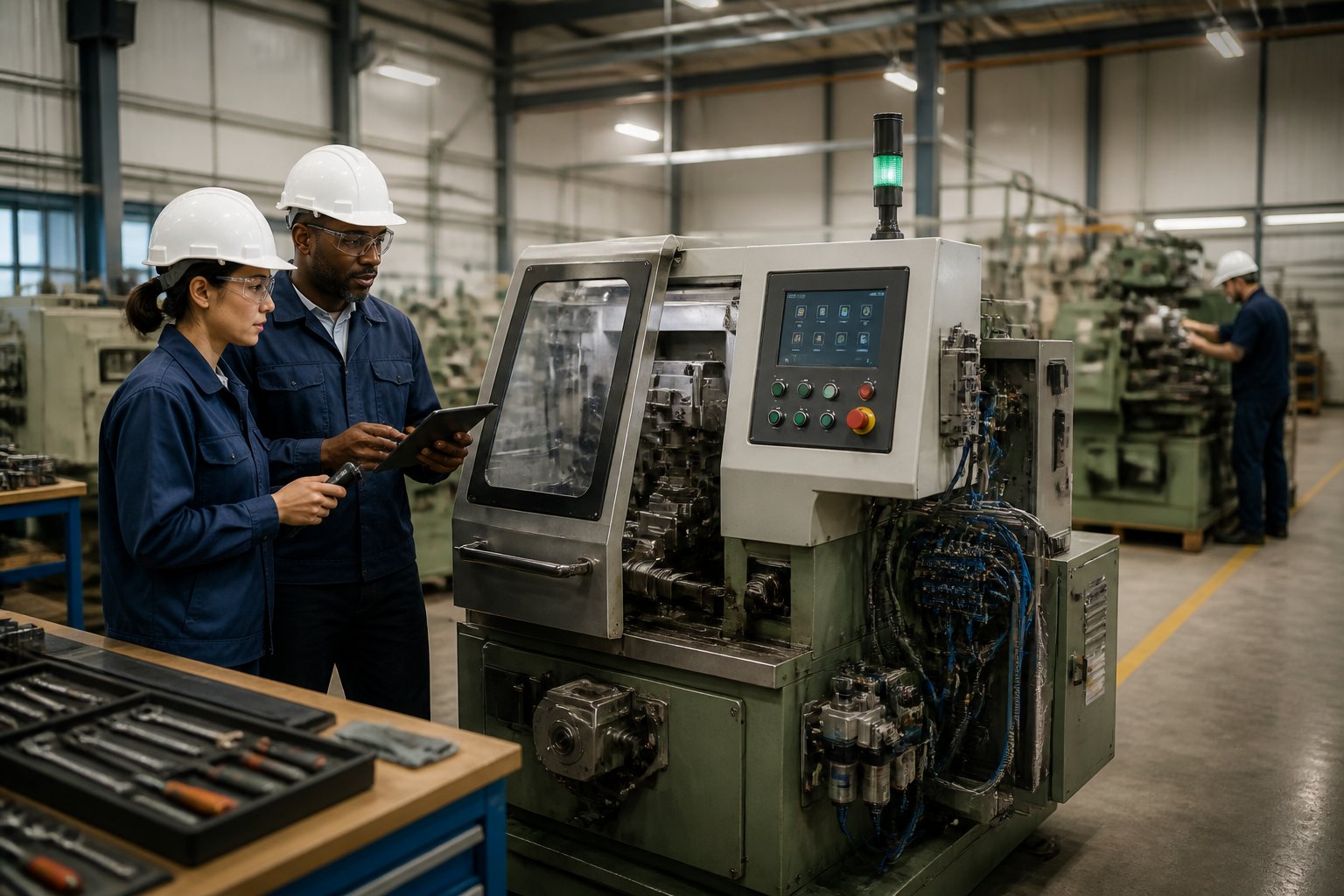
Plenty of legacy machinery is mechanically sound and simply blind. If the frame, drive, and tolerances still hold, you often do not need to replace the asset. You need to instrument it.
Retrofitting is the cash-preserving path. By collecting sensor data directly from older machines, you can feed advanced models without replacing the entire line.
Non-invasive IoT sensors, clamp-on vibration sensors, acoustic sensors, current transducers, and thermal probes can be attached without opening control cabinets. Guidance on retrofitting legacy equipment with non-invasive IoT sensor networks shows how old machines can provide vital sensor data to a modern stack.
Handle the data processing close to the machine using edge computing. Edge devices filter high-frequency signals locally and send only what matters upstream, keeping bandwidth costs and latency manageable across legacy systems.
|
Situation |
Recommended move |
|---|---|
|
Sound mechanics, no visibility |
Retrofit smart sensors and edge gateway |
|
Obsolete controls, good frame |
Control and drive upgrade; retain base machine |
|
Unsupported parts, safety gaps |
Plan replacement on a dated schedule |
|
Throughput ceiling limits growth |
Replace with capacity headroom built in |
Beyond monitoring, incremental automation pays. Low-code platforms and low-code automation tools can digitize inspection rounds and downtime logging in weeks. These tools support continuous operation by identifying bottlenecks before they halt the line.
Targeted robotics on a single station often beats a full-line rebuild. Implementing robotics helps stabilize manufacturing processes by removing variability from repetitive tasks.
Additional strategies for modernizing legacy manufacturing equipment follow the same logic of staged, reversible investment. Successful technology adoption relies on making these digital tools easy for shop-floor workers to use.
Treat digital twins and energy optimization as later-stage Industry 4.0 work. Modern edge computing deployments make this transition easier by localizing data analysis. Earn these Industry 4.0 milestones by first achieving reliability gains.
Finance Replacements With an Agility Reserve
Build a layered structure so each need meets the right instrument:
-
Equipment financing or leasing for planned replacements with predictable useful life
-
Term loans for larger capacity expansions with a defined payback
-
A flexible line of credit held as your agility reserve for emergency replacements
-
Retained maintenance reserves for parts, overhauls, and scheduled rebuilds
That reserve line is the differentiator. Held undrawn, it converts an unplanned failure into a same-week decision rather than a scramble for terms under duress, which is the principle behind maintenance reserves that sustain operations.
On the technology side, shift as much as you can from capital to operating expenses. Using SaaS monitoring, cloud-based analytics, and managed services lets you adopt new capabilities without a heavy hardware refresh cycle.
SMBs increasingly use cloud platforms for financial agility for precisely that reason.
Modern cloud infrastructure and hybrid cloud setups keep latency-sensitive workloads local while cloud-based analytics run remotely. This robust cloud infrastructure allows SMBs to scale their digital tools as production grows.
Protect optionality when you sign. Confirm data export rights and integration standards before committing to any AI platform, whether PTC ThingWorx or a smaller vendor, so vendor lock-in doesn't cap your scalability later.
Ask every service provider what happens to your historical data if you leave. A reliable service provider will offer clear documentation on data portability and support. According to a review of 2026 equipment finance trends for SMBs, equipment investment remains active but uneven. Sequence purchases against demand signals, not vendor promotions.
Build Governance for Secure, Scalable Asset Modernization
Connected assets expand your attack surface. The moment a legacy machine gets a gateway, it becomes an IT concern, and cybersecurity must be part of the retrofit scope rather than a follow-up project. Proactive cybersecurity prevents attackers from accessing sensitive production records and disrupts unauthorized access.
Set four non-negotiables before the first sensor goes live:
-
Network segmentation between production assets and business systems
-
Identity and access control for every vendor, gateway, and remote session
-
Documented data pipelines with defined owners and retention rules
-
Patch and firmware discipline on edge hardware, tracked in your register
Robust change management decides whether any of this sticks. This cultural alignment is essential for the scalability of your technology investments. Technicians who were never consulted will work around a new system, so build alerts into existing shift routines.
Strong change management ensures the crew shapes the thresholds they will ultimately manage.
Review your portfolio on a fixed cadence. A structured technology refresh cadence for growing SMBs keeps replacement decisions sequenced by risk and funding. This review should account for the roi of each digital tool, ensuring that cybersecurity investments grow alongside your connectivity.
Report to leadership in business terms: capacity at risk, downtime hours avoided, energy consumption per unit, and capital deferred. That framing keeps maintenance strategies funded and connects reliability work to operational efficiency on the P&L.
Watch digital transformation developments with a clear head. Future trends in autonomous scheduling and physical AI will matter, but they reward operators who already have clean asset data, defined replacement triggers, and disciplined equipment lifespan tracking in place.
Frequently Asked Questions
How can small and medium-sized businesses reduce equipment and facility downtime?
Start by identifying the three to five assets whose failure stops revenue, then measure their failure history and repair times. Combine condition monitoring on those assets with adequate critical spares and documented restart procedures. Most SMBs find that spare availability and procedure clarity cut downtime faster than any software purchase.
What preventive maintenance strategies help avoid unexpected machinery failures?
Use layered triggers rather than a single calendar: time-based intervals for lubrication and filters, usage-based intervals tied to run hours or cycles, and condition-based triggers from vibration or temperature readings. Track PM completion rates, because unfinished PMs are the most common precursor to unplanned failure.
When should an SMB repair existing equipment versus replace legacy machinery?
Replace when annual repair spend approaches a quarter of replacement cost for two straight years, when parts or vendor support have disappeared, or when the machine caps the throughput your order book requires. Repair or retrofit when the mechanics remain sound, and the deficiency lies in control systems, visibility, or efficiency.
How can businesses finance new equipment without disrupting cash flow?
Match the funding term to the asset's useful life so payments align with the productivity it generates. Equipment financing and leasing preserve working capital better than cash purchases, and monthly obligations should be stress-tested against a realistic downturn in revenue, not your best quarter.
What flexible capital options are available for covering maintenance and replacement costs?
A revolving line of credit is the most useful instrument for unplanned replacements because it sits available and undrawn. Pair it with equipment financing for planned purchases, term loans for expansion, and a funded internal reserve for overhauls and major parts.
How does scheduled maintenance minimize operational disruption and unplanned downtime?
Scheduled work lets you choose the timing, stage parts,s and labor in advance, and consolidate several tasks into one stoppage. That planning typically shortens the outage substantially compared with an emergency repair, and it keeps customer delivery commitments intact because the interruption was in the production plan from the start. It also reduces the risk of human error by allowing technicians to work in a controlled environment rather than under the pressure of a breakdown.
Comments
Post a Comment