Operational Strategy for Facility Expansion and Funding
Let’s be honest: when you’re thinking about expanding your facility, it all boils down to one crucial question—can both your operations and your balance sheet handle the commitment you’re about to make? Rents are climbing just about everywhere, construction deadlines seem to move further out every month, and lenders aren’t as eager as they used to be. Whether you’re a manufacturer ramping up with a new production line or an office operator reworking your footprint for hybrid work, the challenge is the same: how do you make a big, long-term space decision without choking your cash flow six months down the line?

The businesses that really nail this treat space and capital as two sides of the same coin. Don’t green-light a facility expansion until you’ve stress-tested your operational needs, occupancy costs, and funding options—all at once. If you sign the lease first and scramble for financing later, you’re likely to end up with weaker loan terms, a stressed-out construction budget, or a credit line that doesn’t cover what you need.
This kind of planning touches everything—from deciding where your next machining cell goes to figuring out how much credit you need to keep in reserve for payroll when things slow down.
Whether you’re growing your production, opening a new location, or just reworking your lease, you’re constantly juggling trade-offs: do you go for fast revenue, cut costs, or build in flexibility for future growth? Smart expansion isn’t just about spending big up front—it’s about finding the balance between what you pay now and making sure your cash flow holds up for the long haul.
Key Takeaways—What Really Matters
- Look at your operational needs, occupancy costs, and funding capacity as one big decision—never sign a lease or loan before you’ve checked all three together.
- Build a financing plan that matches your debt to the life of your assets—use long-term loans for real estate, and keep flexible funding ready to handle the ups and downs.
- Keep a credit reserve untouched during the buildout, so your daily operations don’t get derailed if the expansion hits a snag.
Build the Lease and Facility Expansion Matrix Before Committing
A facility decision holds up only when four variables are scored together: operational fit, occupancy cost, space flexibility, and funding capacity. Treating any one of these in isolation is how businesses end up locked into space that doesn’t match their growth curve or debt that doesn’t match their asset.

Start with space utilization. Hybrid work models have changed what “enough office space” means; many operators are carrying square footage sized for a five-day-a-week workforce that no longer shows up that way. Before expanding office footprint, run actual badge-swipe or occupancy data against your lease, not headcount projections from three years ago.
Manufacturing plants and modern distribution centers face a different constraint: production and fulfillment capacity. A 20 to 30% annual growth rate, for example, can require a facility expansion of tens of thousands of square feet to keep production lines from becoming a bottleneck, according to a manufacturing facility expansion planning guide. That kind of growth also demands decisions about automation readiness, aisle widths for material flow, and local zoning constraints before the first wall goes up. Conducting rigorous due diligence early ensures that municipal codes, loading docks, and utility capacities align with your operational roadmap.
Layer occupancy costs on top. Rising occupancy costs change the math on whether expansion should happen through an existing lease amendment, a new lease, or a purchase.
A strategic guide to commercial real estate financing notes that owning can convert a recurring rent expense into equity on the balance sheet, while renovating an existing asset avoids the disruption of a full relocation.
Gathering localized market intelligence also clarifies historical rent growth and projected operating expenses. For owner-occupants and investors alike, keeping operational overhead low helps protect the property’s net operating income over the asset’s life.
Maintaining a strong NOI also positions the property favorably if you choose to refinance or recapitalize down the road. Facility sizing must also protect your baseline unit economics. If fixed occupancy costs outpace production margins, higher revenue will not translate into net profit.
Build a simple scoring matrix across locations or scenarios:
| Factor | Weight | Why It Matters |
| Space utilization | High | Avoid paying for capacity you won’t use |
| Occupancy cost trend | High | Determines lease vs. buy economics |
| Customer proximity | Medium | Affects revenue capture, not just cost |
| Maintenance costs | Medium | Older buildings can erode savings from lower rent |
| Sustainability/energy profile | Medium | Utility incentives can offset upgrade costs |
Sound asset management and experienced property management also play a key role. They ensure operational efficiencies and prevent unexpected repairs from degrading the property’s financial performance.
Completing this due diligence protects your capital before committing. Score each option, then integrate your financing strategy before you shortlist finalists for your real estate expansion.
How to Negotiate Lease Flexibility and Tenant Improvements
Lease flexibility protects you from paying for space your operations have already outgrown or shrunk out of. The two negotiation levers that matter most for expanding businesses are the tenant improvement allowance and the right of first offer (ROFO) on adjacent space.

Tenant improvements (TIs) cover the buildout work needed to make a space usable, everything from electrical upgrades for machining equipment to reconfigured office layouts for hybrid collaboration space. Landlords typically offer a TI allowance per square foot, but that figure is negotiable and should scale with lease term length and the tenant’s credit profile. A commercial lease negotiation guide notes that lease terms directly influence the viability of debt financing, so a stronger TI package can also improve a lender’s view of the overall project.
Negotiate expansion rights before you need them, not when space runs out. Securing options for future expansion or a ROFO at initial lease signing preserves flexibility. According to a rundown of proven lease expansion strategies, waiting until you run out of room hands all negotiating leverage to the landlord.
Subleasing rights matter just as much on the way down as expansion rights do on the way up. If hybrid work permanently cuts your office space needs by a third, the ability to sublease unused space without delays waiting for landlord approval can save a full year of dead rent.
Bring in tenant representation early. A real estate advisor working exclusively for the tenant, not the landlord, will benchmark your deal against comparable transactions.
They also flag clauses such as restrictive use provisions or below-market TI caps that a first-time negotiator might miss.
Match Expansion Uses With the Right Business Funding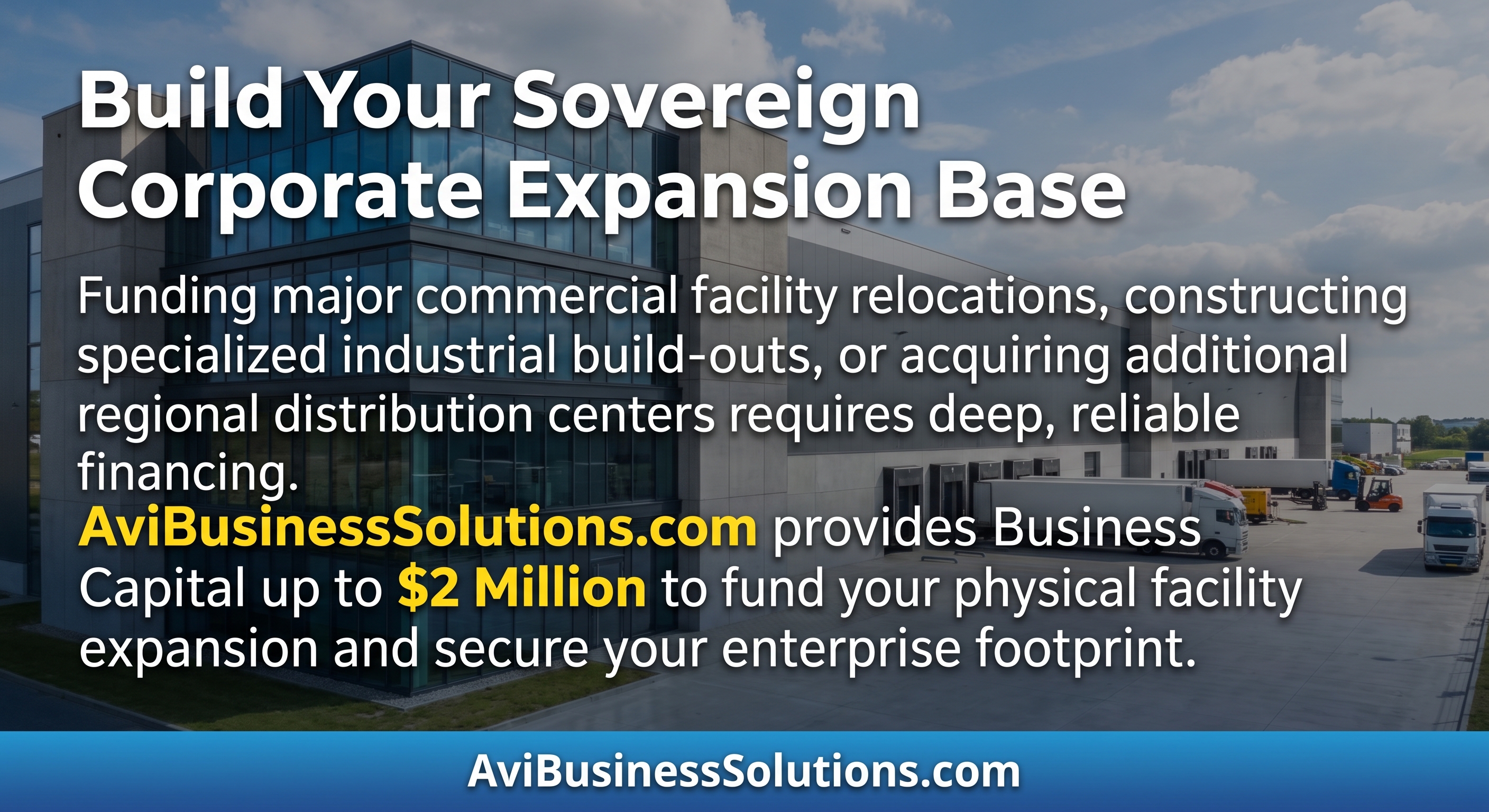
Different expansions require different capital, and stretching a single loan type across all of them is the most common financing mistake in a facility project.
Real estate acquisition and heavy equipment require long-term debt, while buildouts require flexible financing. Evaluating specialized financing products helps operators build a multi-tiered capital stack using a blended financing strategy across distinct business loans.
SBA loans are the standard reference point for owner-occupied real estate. The SBA 7(a) loan works for a blend of uses, real estate, working capital, and business acquisitions, in a single facility up to a program-specific cap. In contrast, the SBA 504 loan is purpose-built for real estate and heavy equipment purchases, typically paired with a conventional first mortgage and a below-market-rate SBA-backed second mortgage. Both carry longer repayment terms than conventional bank loans, which matters when you’re financing an asset that will still be in use in fifteen or twenty years.
Term loans and equipment financing, including tailored equipment loans, are suitable for specific machinery purchases, such as CNC machining centers or robotics equipment. Matching debt structure to the asset life prevents paying for retired machinery.
Because equipment financing rates and broader market interest rates vary by collateral type and credit tier, shopping for terms is essential. Specialized lenders like Crestmont Capital and commercial banks offer fixed monthly payments that provide predictable overhead throughout equipment lifecycles.
Commercial real estate financing covers acquisition, ground-up construction, and refinancing of existing property. Long-term commercial real estate loans give expanding companies the leverage needed to secure prime sites without exhausting operational reserves.
As a strategic explainer on commercial real estate financing describes it, today’s options span everything from ground-up construction to full facility expansions, and the shift from leasing to owning gives a business long-term control over its occupancy costs.
Fintech funding sources such as Qualifi also help businesses rapidly bridge operational shortfalls. Companies using Qualifi gain rapid access to working capital when buildouts encounter unexpected administrative hurdles.
Modern funding partners like Qualifi provide fast access to cash to address construction delays or inventory spikes, without all the tedious paperwork.
For the working capital layer, businesses typically choose among several tools:
- Working capital financing or working capital loans: lump-sum funding for a defined ramp-up period
- Revenue-based financing: repayment tied to a percentage of monthly revenue, useful when cash flow is seasonal
- Asset-based lending, invoice factoring, and inventory financing: credit secured against accounts receivable, customer invoices, or stocked goods, often faster to access than a term loan
- Business lines of credit and revolving credit: A flexible business line of credit works best when expansion unfolds in stages rather than a single closing, as noted in a guide to business expansion financing
For high-margin firms experiencing irregular demand spikes, revenue-based financing can provide flexible capital without rigid monthly repayment dates.
Match the funding term to the asset’s lifespan first, then layer in working capital tools to smooth out timing gaps between spending and revenue.
Protect Cash Flow With Working Capital and Credit Reserves
Working capital keeps daily operations running while a facility expansion absorbs cash for months before it generates revenue. Even a fully approved, fully funded expansion can create a cash crunch if payroll, supplier payments, and debt service aren’t modeled separately from the construction budget.
Build a 13-week rolling cash flow projection before you break ground or sign a new lease.
This projection helps you spot potential cash flow gaps before they happen. It should account for delayed rent abatement periods, phased tenant improvement draws, and the lag between hiring new staff and the revenue they produce.
A business line of credit is an effective tool for this gap because it provides revolving credit. This revolving credit structure allows companies to draw funds only as needed, paying interest only on the outstanding balance rather than carrying an expensive lump sum.
Keep your operational line separate from your expansion debt. Using the same facility for both construction overruns and payroll is how businesses lose track of their real liquidity position.
Alternative funding platforms like Qualifi can serve as a separate liquidity buffer. This keeps core operational accounts insulated from the unpredictability of construction.
Accounts receivable financing is a second lever, particularly for manufacturers and distributors carrying 45- to 60-day payment terms with commercial customers. Converting receivables into available cash shortens the gap between shipping product and collecting payment, which matters more during an expansion, when inventory and staffing costs rise before new capacity generates full revenue.
Set a minimum reserve threshold and treat it as untouchable. A common approach is to hold three to six months of fixed operating costs, rent, payroll, and debt service in cash or in an undrawn line of credit, separate from the capital earmarked for the expansion itself. That reserve is your risk mitigation against a slow lease-up, a delayed opening, or a customer contract that starts later than planned.
Prepare for Lender Underwriting and a Sustainable Debt Load
Lenders underwriting a facility expansion loan in 2026 are more conservative and data-driven than in recent years, according to an overview of how commercial lenders underwrite real estate deals. Recent insights from the Federal Reserve’s small business credit survey reflect similar tightening, noting that complete financial documentation significantly increases the odds of approval. Preparing your financial picture early shortens the review process and improves your terms.
Lenders weigh several factors together, not any single number in isolation:
- Credit profile and guarantees: lenders review both personal and business credit scores, and most commercial contracts require an explicit personal guarantee from equity partners
- Debt service coverage ratio (DSCR) and net operating income: measures whether cash flow covers loan payments; lenders evaluate baseline NOI to verify that operations produce sufficient income after operating expenses
- Collateral: the real estate or equipment being financed typically secures the loan, and lenders will assess the loan-to-value ratio against the current appraised value, not the projected future value.
- Down payment: expect a meaningful equity contribution on real estate deals, since it directly affects the lender’s risk exposure
- Interest rates and origination fees: these vary by loan type and lender, and origination fees can meaningfully change the effective cost of capital on top of the stated rate
- Repayment terms and prepayment penalties: match the term to the asset’s useful life, and read the prepayment terms closely if you expect to refinance or sell within the first few years
Build your cash flow projections around a stress-tested scenario, not your best-case revenue forecast. Factoring in potential changes in interest rates alongside conservative revenue projections helps ensure your balance sheet remains resilient.
A lender modeling DSCR will want to see how the numbers hold up if the new facility ramps up more slowly than planned, and you’re better off finding that answer before submission than after a declined application.
Choose a Funding Structure That Keeps Expansion Flexible
The most resilient facility expansion strategy pairs long-lived assets with long-term debt while keeping working capital tools separate and untouched for operational volatility. This structured approach builds a reliable foundation for sustainable business growth without jeopardizing daily liquidity.
Real estate and heavy equipment, machining centers, robotics installations, and industrial ovens are typically financed over 10- to 25-year terms through SBA 504 loans, conventional commercial mortgages, or equipment-specific term loans. These assets generate revenue for years, so the debt financing them should stretch across a comparable horizon. Manufacturing financing programs, including SBA loans, are specifically structured for this kind of long-lived asset purchase.
Tenant improvements and short-term operational costs, hiring ahead of revenue, initial inventory build, and marketing into a new market belong on shorter-term or revolving facilities. Flexible business lines of credit or a working capital loan absorb these costs without tying up decades of repayment against something that won’t still be generating value in five years.
Responsive lenders like Qualifi offer extra bridge funding during build-outs. These options help business owners manage unexpected contractor costs without having to renegotiate with their main bank.
Keep lease flexibility in the funding conversation, too. A shorter initial lease term with a strong renewal option can reduce the upfront capital commitment, giving you room to prove out the expansion before locking into a fifteen-year real estate purchase. This is where expansion planning, financing structure, and lease strategy intersect directly.
The risk-mitigation principle underlying all of this: never let a single financing facility carry both a fixed, long-term obligation and your variable, month-to-month operating risk. Separate the two, and a downturn in one won’t force a default in the other.
Conclusion

A facility expansion succeeds when operational need, occupancy costs, and funding capacity are evaluated as a single decision rather than three separate approvals. Lease flexibility and a well-negotiated tenant improvement allowance protect you from paying for space that no longer fits your business.
Matching long-term debt to long-lived assets, while keeping a working capital reserve untouched for day-to-day volatility, is what keeps ambitious business growth from turning into a cash-flow problem 18 months in.
Bring your lender, your real estate advisor, and your own cash flow projections into the room at the same time, before any lease or loan document gets signed.
Frequently Asked Questions
What’s the difference between an SBA 7(a) loan and an SBA 504 loan for facility expansion?
An SBA 7(a) loan covers a broader mix of uses, including real estate, working capital, and business acquisitions, within a single loan structure. An SBA 504 loan is designed specifically for real estate and major equipment purchases, typically pairing a conventional first mortgage with a below-market SBA-backed second mortgage, and generally offers longer fixed terms for the real estate portion.
How much working capital should a business keep in reserve during a facility expansion?
A common benchmark is three to six months of fixed operating costs, rent, payroll, and existing debt service, held separately from the funds earmarked for the expansion itself. That reserve, ideally in cash or an undrawn business line of credit, absorbs delays in construction or lease-up without forcing cuts to daily operations.
Should a business use a line of credit or a term loan to fund tenant improvements?
Tenant improvements are usually better suited to revolving credit, such as a business line of credit, or a short-term working capital loan because buildout draws are variable. Reserve long-term loans for the real estate or equipment itself, since matching short-lived project costs to a multi-decade loan ties up borrowing power.
What do commercial real estate lenders look for most closely when underwriting a facility loan?
Lenders weigh the debt service coverage ratio, collateral value, and credit history together, along with the down payment amount and projected cash flow under a stress-tested scenario. A DSCR comfortably above 1.0x, adequate collateral coverage, and a well-documented cash flow projection improve both approval odds and pricing.
Is it better to lease or buy commercial real estate for a growing manufacturing operation?
Buying converts recurring rent into equity and gives full control over facility modifications, which matters for manufacturers installing heavy equipment or specialized infrastructure. Leasing preserves capital and flexibility for businesses that are still validating growth projections or are uncertain about long-term space needs, making the right choice depend on how confident you are in your five- to ten-year capacity plan.
#FacilityExpansion #BusinessFinancing #CommercialRealEstate #BusinessGrowth #WorkingCapital
Comments
Post a Comment